At a glance
2–3 days
Trams, city buses and the frequent ferry cover the main route. On Sakurajima, the Island View bus serves principal stops, but a full circuit needs more planning. Do not assume distant viewpoints are walkable from the ferry.
Autumn through spring is comfortable; summer is hot with typhoon risk. Volcano and ash conditions matter in every season.
Core relationships are source-checked. Reconfirm transport and facility details before departure.
Why this town matters
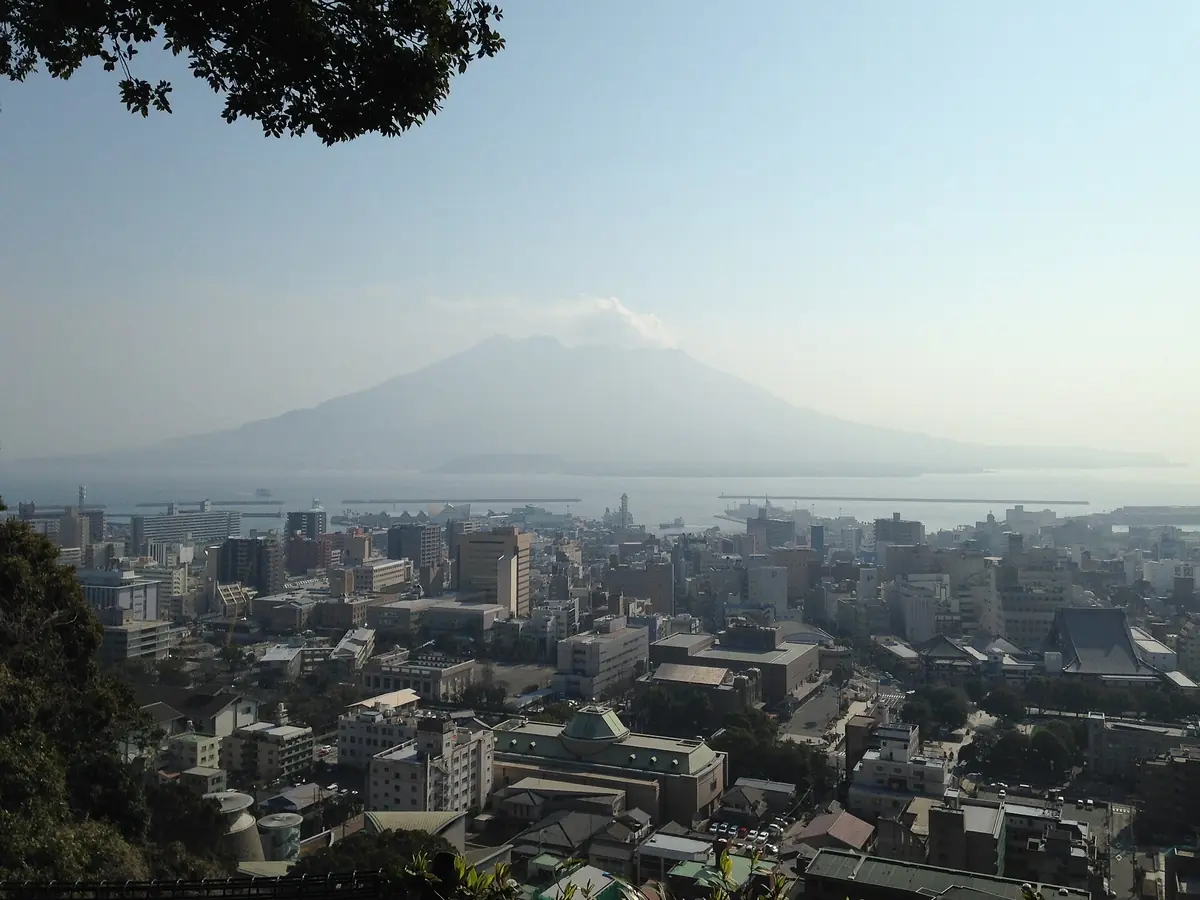
Kagoshima’s defining view is not scenery detached from city life: Sakurajima is an active volcano across a ferry route used every day. The former Satsuma domain’s role in political and industrial change adds a second major story, while ash management, local agriculture and public baths show how residents live with the landscape.
Works, people, history and culture
- The Shimazu family and the Satsuma domain
- Satsuma’s role in nineteenth-century political and industrial change
- Sakurajima as an active volcano within the urban bay
- Ferry, tram, onsen and food cultures adapted to a warm southern city
What to see
- Sakurajima Visitor Center and lava-shore walk
- Sengan-en and its industrial-heritage context
- Kagoshima City Museum of the Meiji Restoration
- Shiroyama and the central city
- Tenmonkan, markets and a local onsen
See it now · Live video
Check current conditions
Sakurajima and its plume conditions across Kinko Bay from an established local broadcaster.
Sakurajima across Kagoshima Bay
Useful for a visual check only. Always follow Japan Meteorological Agency and local emergency information for volcanic safety.
- Camera operator
- MBC South Japan Broadcasting
- Checked
- 22 August 2026
This provider does not expose a verified stable direct stream, so its current-view page opens in a new tab. Availability, angle and update frequency can change. Use official weather, transport and emergency notices for decisions that affect safety.
Getting there
From Tokyo, major stations or airports
The Kyushu Shinkansen terminates at Kagoshima-Chuo, with direct services from Hakata. Airport buses connect Kagoshima Airport with the center. Trams or buses continue to the Sakurajima ferry terminal.
Getting around locally
Trams, city buses and the frequent ferry cover the main route. On Sakurajima, the Island View bus serves principal stops, but a full circuit needs more planning. Do not assume distant viewpoints are walkable from the ferry.
2–3 days
Autumn through spring is comfortable; summer is hot with typhoon risk. Volcano and ash conditions matter in every season.
Food, onsen and local culture
Kurobuta pork, local black beef and chicken, satsuma-age, shirokuma shaved ice, sweet-potato shochu and public onsen make Kagoshima highly rewarding after dark as well as during sightseeing hours.
Connect neighboring towns
Use one day for Satsuma and city history and another for Sakurajima. Continue to Nagasaki only as part of a multi-day Kyushu rail journey, not a same-day transfer-and-tour.

Nagasaki and Kagoshima: two southern port cities
Give each city time for difficult history, international exchange and living waterfront geography, with a dedicated rail-transfer day between them.
Nagasaki · KagoshimaOpen route →Etiquette and safety
Check official opening, weather and transport notices before departure. Temples, shrines, museums, historic streets and residential lanes are shared community spaces: keep routes clear, follow photography rules and never enter private property. Sakurajima is active. Follow Japan Meteorological Agency and local instructions, respect exclusion zones, carry eye protection when ash is heavy and never enter closed roads or trails.
Questions before you choose Kagoshima
How much time should I allow?
2–3 days. This is the practical minimum for seeing the town without turning transport into the main activity.
Can I visit without a car?
Trams, city buses and the frequent ferry cover the main route. On Sakurajima, the Island View bus serves principal stops, but a full circuit needs more planning. Do not assume distant viewpoints are walkable from the ferry.
When is the best time to go?
Autumn through spring is comfortable; summer is hot with typhoon risk. Volcano and ash conditions matter in every season.
Information checked: 22 August 2026
Source register
Sources used for this page
Reconfirm changing information with the responsible organization before travel.
- Visit Kagoshima City official guideKagoshima Convention and Visitors Bureau · Official tourism organization · checked 22 August 2026
- Access to SakurajimaSakurajima Visitor Center · Official visitor center · checked 22 August 2026
- Sakurajima Visitor CenterSakurajima Visitor Center · Official visitor center · checked 22 August 2026
- Responsible travel in JapanJapan National Tourism Organization · National tourism organization · checked 22 August 2026