At a glance
2 days; 3 with Horyuji or southern Nara
Walk the eastern park carefully and use buses for wider sites. The loop bus serves principal stops, but distances inside the park remain substantial. Nishinokyo and Heijo Palace require a separate half-day.
Spring and autumn are beautiful and crowded; early mornings and winter weekdays offer quieter temple visits; summer heat is significant.
Core relationships are source-checked. Reconfirm transport and facility details before departure.
Why this town matters
Nara is often compressed into deer and Todaiji, but the former capital is a connected landscape of court planning, powerful temples, Kasuga belief, protected forest and later merchant life. A full day reveals the eastern park; a second shows that Nara’s historical geography extends west and south.
Works, people, history and culture
- Heijo-kyo and the establishment of the eighth-century capital
- Todaiji, Kohfukuji and the political power of Buddhist institutions
- Kasugataisha, sacred deer and Kasugayama Primeval Forest
- Naramachi and the commercial city that developed after the capital era
What to see
- Todaiji and the Great Buddha Hall
- Kasugataisha and the forest approach
- Kohfukuji and the Nara National Museum
- Naramachi
- Heijo Palace Site or the Nishinokyo temples on a second day
See it now · Live video
Check current conditions
The sky above Nara Park and Mt Wakakusa from a local transport operator's camera.
Nara Park skyline and Mt Wakakusa
Useful for current visibility and weather; it is a local operator feed rather than a municipal tourism service.
- Camera operator
- NaLIVE / Hattori Taxi
- Checked
- 22 August 2026
This provider does not expose a verified stable direct stream, so its current-view page opens in a new tab. Availability, angle and update frequency can change. Use official weather, transport and emergency notices for decisions that affect safety.
Getting there
From Tokyo, major stations or airports
Kintetsu trains provide convenient access from Kyoto and Osaka-Namba; JR services connect Kyoto, Osaka and Nara by different routes. Kintetsu-Nara is closer to Nara Park, while JR Nara is useful for the older commercial streets.
Getting around locally
Walk the eastern park carefully and use buses for wider sites. The loop bus serves principal stops, but distances inside the park remain substantial. Nishinokyo and Heijo Palace require a separate half-day.
2 days; 3 with Horyuji or southern Nara
Spring and autumn are beautiful and crowded; early mornings and winter weekdays offer quieter temple visits; summer heat is significant.
Food, onsen and local culture
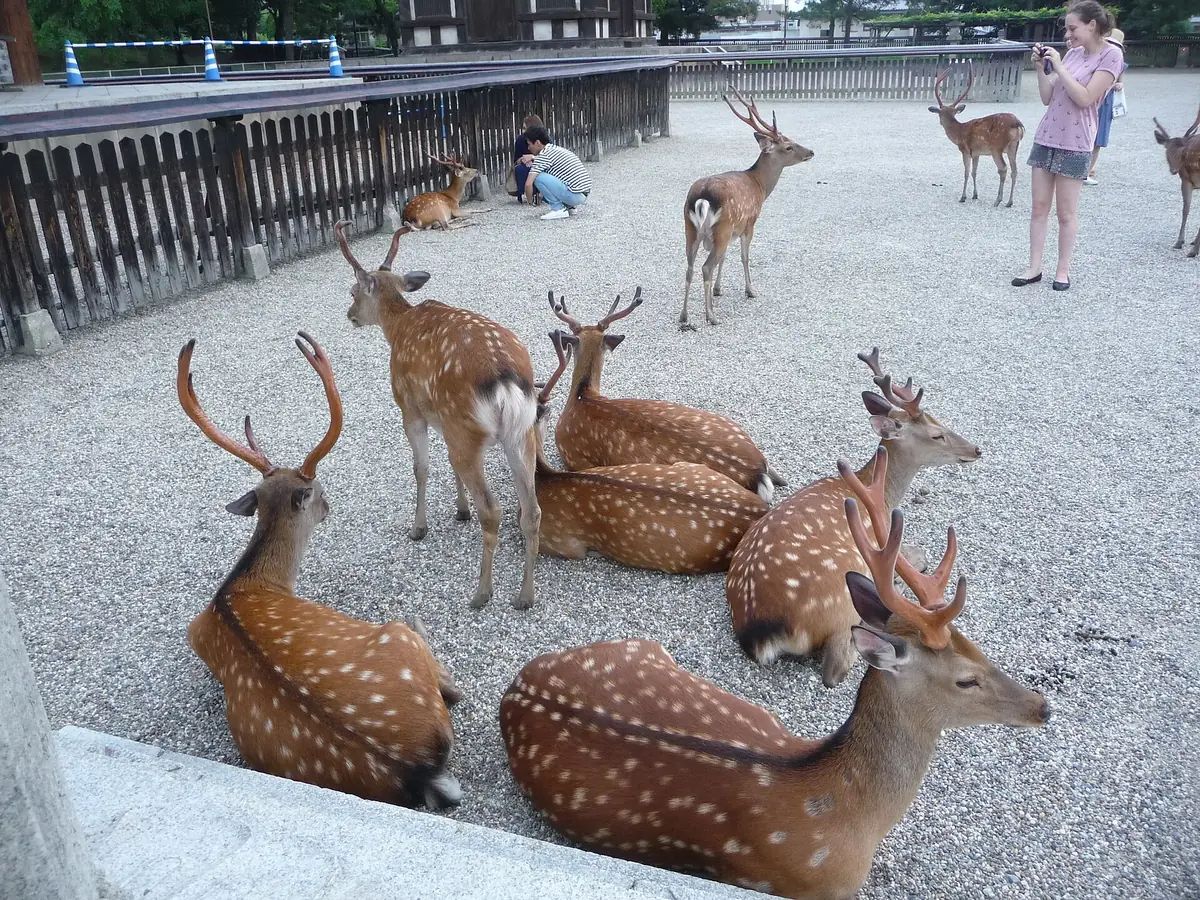
Kakinoha-zushi, narazuke, somen, tea and refined sweets connect the basin with temple and merchant history. Deer are wild protected animals, not props.
Connect neighboring towns
Use one full day from Todaiji through Kasugataisha and Naramachi, then a second for Heijo Palace or Nishinokyo. Uji forms a coherent literary and ancient-culture continuation.
.jpg)
Uji and Nara beyond the Kyoto day trip
Connect Heian literature and tea beside the Uji River with the temples, court history and sacred landscape of ancient Nara.
Uji · NaraOpen route →Etiquette and safety
Check official opening, weather and transport notices before departure. Temples, shrines, museums, historic streets and residential lanes are shared community spaces: keep routes clear, follow photography rules and never enter private property. Feed deer only authorized shika senbei, never tease or touch them, secure paper and plastic, and supervise children around antlered or food-seeking animals.
Questions before you choose Nara
How much time should I allow?
2 days; 3 with Horyuji or southern Nara. This is the practical minimum for seeing the town without turning transport into the main activity.
Can I visit without a car?
Walk the eastern park carefully and use buses for wider sites. The loop bus serves principal stops, but distances inside the park remain substantial. Nishinokyo and Heijo Palace require a separate half-day.
When is the best time to go?
Spring and autumn are beautiful and crowded; early mornings and winter weekdays offer quieter temple visits; summer heat is significant.
Information checked: 22 August 2026
Source register
Sources used for this page
Reconfirm changing information with the responsible organization before travel.
- Nara for first-time visitorsNara City Tourism Association · Official tourism organization · checked 22 August 2026
- Nara’s sacred deerNara Prefecture Visitor Bureau · Official tourism organization · checked 22 August 2026
- Responsible travel in JapanJapan National Tourism Organization · National tourism organization · checked 22 August 2026